Yield vs. Watershed: Why the Science Guiding American Agriculture Is Failing Our Rivers
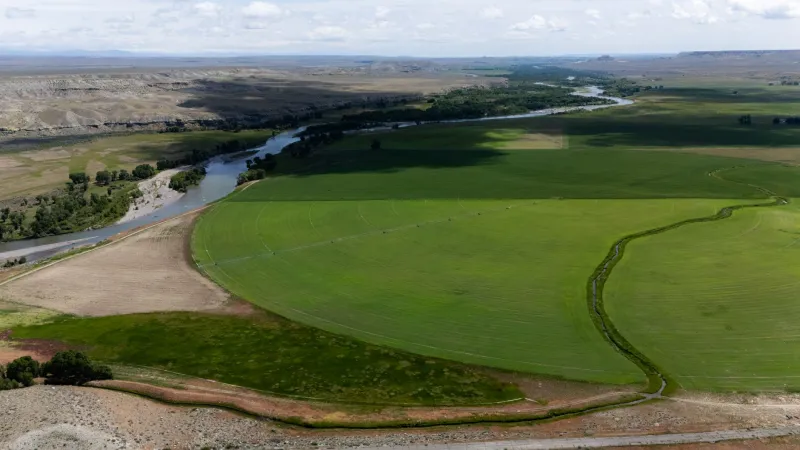
Let us be precise about what we mean when we say that American agriculture has been at war with its rivers. We do not mean that farmers, as individuals, are indifferent to the land or the water. Many are not. We mean something more structural and more troubling: that the scientific institutions tasked with guiding agricultural practice in this country have, for most of the past century, optimized relentlessly for a single variable—crop yield—while treating the ecological consequences of that optimization as externalities too inconvenient to measure.
The results are visible in every major river basin in the agricultural United States. The Mississippi River carries an estimated 1.5 million metric tons of nitrogen to the Gulf of Mexico each year, the majority of it originating from Corn Belt agriculture. The resulting hypoxic dead zone off the Louisiana coast has, in recent years, grown to an area exceeding 6,000 square miles. The Iowa River runs green with algae through summer. The Platte, the Kansas, the Illinois—river after river bears the chemical signature of a production system that has never been asked to account for what it costs the water.
The Research Apparatus and Its Loyalties
Understanding how this happened requires a clear-eyed look at how agricultural science in America is funded and organized. The land-grant university system, established by the Morrill Act of 1862 and expanded through subsequent legislation, was designed to place agricultural research in direct service of production. That mission has not fundamentally changed. The research priorities of institutions like Iowa State University, the University of Illinois, and Purdue University remain heavily shaped by the commodity agriculture industries that provide substantial private funding alongside public appropriations.
The result is a research ecosystem that has produced extraordinary advances in crop genetics, precision application technology, and farm equipment efficiency—all measured against the benchmark of yield. Independent research into the watershed-scale consequences of those advances has been comparatively underfunded, fragmented across agencies and disciplines, and often deprioritized in favor of work with clearer commercial applications.
"The question we were never really asked to answer," says Dr. Ellen Hargrove, a watershed hydrologist who spent fifteen years at a Midwestern land-grant institution before moving to independent research, "was what all of this looks like from the river's perspective. That question didn't fit the funding model."
Hargrove is among a growing cohort of scientists who argue that restoring degraded rivers in agricultural landscapes requires not just new practices but a fundamentally different scientific framework—one that treats ecological recovery as a primary metric of success rather than an afterthought.
Regenerative Agriculture and the Evidence Gap
In fields across Iowa, Minnesota, and Illinois, a different kind of farming experiment is underway. Farmers working with organizations like the Practical Farmers of Iowa and the Land Stewardship Project are implementing cover cropping, extended rotations, reduced tillage, and the restoration of prairie strips and wetland buffers. Their motivations are varied—some are driven by soil health concerns, others by economics, others by a genuine commitment to the rivers that border their land. What many share is frustration with a research establishment that has been slow to study what they are already doing.
James Kroeger farms 1,400 acres in Ringgold County, Iowa, and has been transitioning his operation toward regenerative practices over the past eight years. He installed constructed wetlands on two of his fields six years ago, following guidance from the Iowa Nutrient Reduction Strategy. Monitoring data collected in partnership with a regional watershed management authority shows measurable reductions in nitrate loading to the tributary that crosses his property.
"I can see the difference in the creek," Kroeger says. "I just wish there was more rigorous science following what guys like me are doing, because right now I'm operating somewhat on faith and observation."
That evidence gap is precisely what river restoration scientists are pressing to close. The challenge is methodological as much as financial. Agricultural watersheds are complex, variable systems. Isolating the effect of a particular practice on downstream water quality requires long-term monitoring, replicated study sites, and the kind of patient, place-based research that runs against the grain of academic incentive structures oriented toward rapid publication.
Redefining the Metric
The most provocative argument emerging from this community is not simply that we need more research into regenerative agriculture. It is that we need to fundamentally reconsider what agricultural success means. If a farm produces exceptional corn yields while contributing to the degradation of a river system that supplies drinking water to downstream communities, destroys aquatic habitat, and contributes to a coastal dead zone measured in thousands of square miles—is that farm successful? The conventional accounting says yes. A watershed-centered accounting says the question is far more complicated.
This is not an argument against productive agriculture. It is an argument that productivity must be redefined to include the full system, not merely the field. Economists call this internalizing externalities. Ecologists call it whole-system thinking. Farmers who have spent years watching their local streams degrade call it common sense.
Some policy mechanisms are beginning to move in this direction. The Conservation Reserve Program and the Agricultural Conservation Easement Program provide financial incentives for practices that protect water quality, though funding remains chronically insufficient relative to need. The latest Farm Bill negotiations have seen renewed advocacy for expanding conservation title funding, with river and watershed organizations arguing that public agricultural subsidies should be explicitly conditioned on measurable environmental performance.
The Science We Actually Need
What would a genuinely watershed-centered agricultural science look like? It would fund long-term, landscape-scale monitoring of the relationship between farming practices and river health. It would involve hydrologists, ecologists, and river restoration specialists as equal partners in research design alongside agronomists and economists. It would measure success not only in what a field produces but in what it contributes to—or withholds from—the water moving through and beyond it.
It would also take seriously the knowledge that farmers themselves possess about their land and their waterways—knowledge that academic institutions have historically undervalued in favor of controlled experimental data.
The rivers of the American agricultural heartland did not degrade overnight, and they will not recover quickly. But the trajectory is a choice, not an inevitability. The science exists to guide better decisions. What is needed now is the institutional courage to fund it honestly, and the political will to act on what it reveals.