Dam Builders by Design: The Remarkable Science of Beaver-Led River Recovery
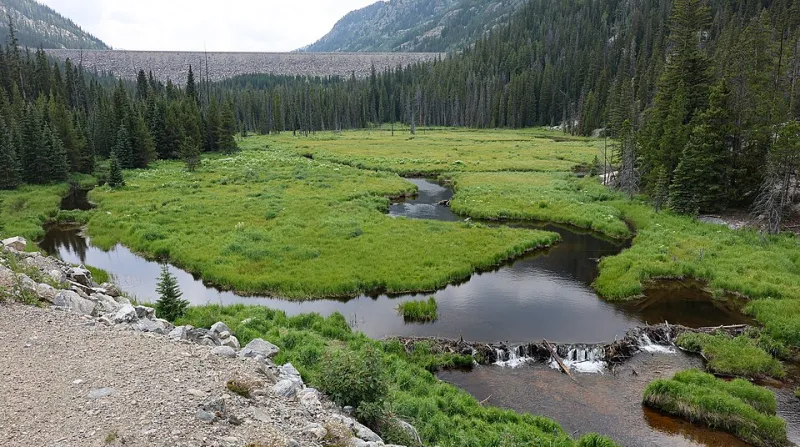
Photo: Jeffrey Beall, CC BY 4.0, via Wikimedia Commons
For much of the twentieth century, American land managers viewed the North American beaver (Castor canadensis) as a nuisance—a creature whose dams flooded roads, drowned timber stands, and complicated the tidy management of engineered waterways. Trapping campaigns, drainage programs, and outright extermination reduced beaver populations from an estimated 60 to 400 million animals at the time of European contact to fewer than 10 million by the mid-1900s. The rivers left behind were, in ways we are only now fully measuring, profoundly impoverished.
Today, a growing body of scientific research and an expanding network of on-the-ground restoration projects are reversing that judgment entirely. Across degraded streams in Oregon, Wyoming, Nevada, and beyond, wildlife managers, hydrologists, and Indigenous land stewards are not merely tolerating beavers—they are actively recruiting them as partners in the most ambitious water restoration effort the West has seen in generations.
What a Beaver Dam Actually Does to a Watershed
To understand why beavers have become central to modern restoration science, it helps to look closely at the hydrology behind a single beaver pond. When a dam forms, water that would otherwise race downstream during spring snowmelt is instead captured, spreading laterally across the floodplain. This slow-release mechanism does something no concrete retention structure can fully achieve: it forces water downward through stream sediments, recharging the shallow aquifers that sustain vegetation, wetlands, and baseflows throughout the dry summer months.
Researchers at Utah State University's Watershed Sciences department have documented stream reaches where beaver activity raised the water table by as much as two to three feet within a single season. In a region where many rivers now run dry by August—an increasingly common reality under accelerating climate change—that stored water is not a minor amenity. It is the difference between a living riparian corridor and a cracked, eroded channel bed.
Beyond water storage, beaver ponds function as remarkably effective natural filtration systems. As sediment-laden water pools behind a dam, suspended particles settle to the bottom, carrying with them agricultural nutrients, heavy metals, and other pollutants that would otherwise travel downstream. Studies published in peer-reviewed journals including Freshwater Biology and Ecological Engineering have found that beaver-influenced reaches can reduce nitrogen and phosphorus loads by 20 to 45 percent—performance metrics that rival engineered constructed wetlands built at substantial public expense.
Beavers as Wildfire Buffers
Perhaps the most consequential discovery of the past decade involves a connection that few would have predicted: the relationship between beaver activity and wildfire resilience. As catastrophic fires have swept through Western landscapes with increasing frequency and intensity, satellite imagery and post-fire field surveys have repeatedly shown that beaver-maintained wetland complexes survive burning events with strikingly greater vegetation cover than surrounding uplands.
The mechanism is straightforward. Beaver ponds maintain saturated soils and lush, green riparian vegetation even during the hottest and driest periods of the fire season. When a wildfire burns to the edge of an active beaver complex, it frequently slows, drops in intensity, or stops entirely. The Baugh Creek fire in Idaho, which burned more than 100,000 acres in 2018, provided one of the most visually compelling examples: aerial photographs showed ribbons of intact, green riparian habitat winding through blackened hillsides—each corridor corresponding precisely to an active beaver colony.
For fire-prone communities in the West, this finding carries enormous practical significance. Restoring beaver populations along mountain streams and canyon drainages may represent one of the most cost-effective fire mitigation strategies available, requiring no mechanical intervention once animals are established.
The Practice of Beaver-Assisted Restoration
Translating ecological science into restoration practice has required creativity, patience, and a willingness to work on the beaver's timeline rather than a project manager's. Several techniques have emerged as particularly effective.
Beaver Dam Analogues (BDAs) are hand-built structures—typically wooden posts woven with willow branches and native vegetation—that mimic the form and hydraulic function of a natural beaver dam. Installed by restoration crews, BDAs slow stream velocity, begin accumulating sediment, and, critically, provide a foundation that wild beavers frequently colonize and reinforce with their own construction. Projects using BDAs in Nevada's Humboldt River basin and along degraded tributaries of the Powder River in Wyoming have documented stream incision reversal, measurable water table rise, and successful beaver colonization within two to three years.
Translocation programs move beavers from areas where human-wildlife conflict is high—suburban ponds, irrigated farmland—to degraded stream reaches where their engineering instincts can be deployed to maximum ecological benefit. The Methow Beaver Project in Washington State has become a model for such efforts, working with ranchers, tribal nations, and state agencies to relocate animals and monitor their subsequent impact on stream function.
Critically, successful projects invest heavily in community relationships. Ranchers and farmers whose irrigation systems or pastures sit downstream of potential beaver activity have legitimate concerns. Effective programs provide technical support, install flow devices that prevent unwanted flooding, and share hydrological monitoring data that demonstrates measurable benefits to water availability—a powerful persuasive tool in water-scarce Western communities.
Indigenous Knowledge and the Long View
It is worth acknowledging that the scientific community's enthusiasm for beaver restoration represents a rediscovery of ecological relationships that Indigenous peoples across North America understood for centuries. Many tribal nations maintained cultural and practical relationships with beavers as landscape architects long before European settlers began systematically eliminating them. Restoration programs that engage tribal nations not merely as stakeholders but as knowledge partners—drawing on oral histories, traditional ecological knowledge, and Indigenous land management practices—consistently produce richer, more durable outcomes.
The Confederated Salish and Kootenai Tribes in Montana and the Yurok Tribe in California have both integrated beaver restoration into broader watershed stewardship programs, bringing perspectives that extend well beyond the timeframes of conventional grant-funded projects.
The Work Ahead
Beaver-assisted restoration is not a universal solution. It works best in specific geomorphic and hydrological contexts—incised streams with adequate food resources and appropriate channel gradients. It requires sustained monitoring, adaptive management, and genuine investment in the human relationships that determine whether a beaver colony is welcomed or removed.
But in a West grappling simultaneously with intensifying drought, catastrophic wildfire, declining aquifer levels, and degraded water quality, the beaver's return represents something genuinely rare in conservation: a strategy that addresses multiple crises at once, at a fraction of the cost of engineered alternatives, and with the durability that only a living ecosystem can provide.
The rivers that beavers built over millennia were among the most productive, water-retentive, and biologically diverse systems on the continent. Rebuilding them—dam by patient dam—may be one of the most consequential investments American conservation can make.