The Long Journey of a Nitrogen Molecule: Tracing Farm Runoff from Midwest Fields to Gulf Coast Dead Zones
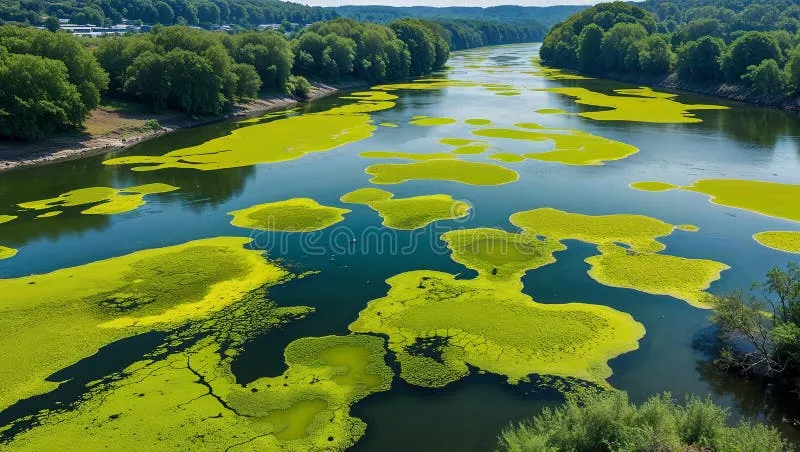
Photo: agricultural runoff flowing into river with green algae bloom aerial view, via thumbs.dreamstime.com
Imagine following a single molecule of nitrogen from the moment it is applied to a soybean field in central Iowa in early spring. It may spend days or weeks in the soil before heavy rains arrive. Then, rather than being absorbed by plant roots or captured by soil microbes, it dissolves into water moving across the surface or percolating through the earth into subsurface drainage tiles — the buried pipe networks that keep millions of acres of Midwestern farmland dry enough to cultivate. From there, it enters a ditch, then a tributary, then the Des Moines River, then the Mississippi, traveling southward for hundreds of miles before reaching the Gulf of Mexico somewhere off the Louisiana coast.
There, in warm, stratified coastal waters, that nitrogen molecule does not simply disappear. It feeds an explosion of algae. The algae die and sink. Bacteria decompose them, consuming oxygen in the process. The water around them becomes hypoxic — depleted of dissolved oxygen to levels at which fish, shrimp, and crabs cannot survive. The molecule that left an Iowa field as a routine agricultural input has become a building block of one of the most persistent and damaging ecological phenomena in American coastal waters: the Gulf of Mexico dead zone.
The Science of Nutrient Pollution, Plainly Stated
Nutrient pollution — the overloading of water bodies with nitrogen and phosphorus — is among the most widespread water quality problems facing the United States today. Unlike many contaminants, nitrogen and phosphorus are not inherently toxic. They are, in fact, essential to life. The problem is one of excess and displacement: when these elements accumulate in aquatic systems at concentrations far beyond what natural processes can absorb, they drive a cascade of biological responses that systematically degrade water quality and ecosystem function.
The primary mechanism is eutrophication. Elevated nutrient levels stimulate the rapid growth of algae and cyanobacteria, organisms that can double their populations within hours under favorable conditions. These algal blooms shade out submerged aquatic vegetation, disrupting the habitat structure that fish and invertebrates depend on. When bloom organisms die and decompose, the bacterial respiration process consumes dissolved oxygen at rates that can plunge entire water columns into hypoxia — conditions below 2 milligrams of oxygen per liter, at which most fish and bottom-dwelling organisms must flee or die.
In enclosed or stratified water bodies, including the shallow coastal shelf of the northern Gulf of Mexico, this hypoxic layer can persist for months. The 2023 Gulf dead zone measured approximately 3,058 square miles — smaller than some previous years but still representative of a chronic, structurally embedded problem that has persisted for decades and shows no signs of spontaneous resolution.
Following the Water Through the Mississippi Basin
The Mississippi River and its tributaries drain approximately 41 percent of the contiguous United States, a watershed encompassing the most productive agricultural landscape on earth. The river carries the chemical signature of that productivity. U.S. Geological Survey monitoring data consistently show that the Mississippi delivers between 1.5 and 1.7 million metric tons of dissolved nitrogen to the Gulf each year, the majority of it originating from agricultural sources in Illinois, Iowa, Indiana, Missouri, and Minnesota.
The pathway from field to coast is accelerated by the extensive network of subsurface drainage tiles installed across the Midwest over the past century and a half. These tiles, originally engineered to make poorly drained prairie soils agriculturally viable, are extraordinarily efficient at moving water — and the nutrients dissolved in it — out of fields and into stream networks. Studies by the University of Illinois and Iowa State University have found that tile drainage can account for the majority of nitrate loading in some Midwestern watersheds, bypassing the natural filtration processes that would otherwise occur as water moves slowly through wetlands and riparian zones.
The rivers that receive this drainage — the Illinois, the Ohio, the Missouri, the Tennessee — carry elevated nutrient loads throughout the growing season and well into autumn. By the time this water reaches the Gulf, it has traveled through thousands of miles of river channel, past cities, farms, and industrial facilities, accumulating additional inputs along the way. The dead zone that forms each summer is the cumulative result of that entire watershed's nutrient budget.
Policy Failures and the Voluntary Approach's Limits
The scientific understanding of this problem is not new. The Gulf Hypoxia Action Plan, a federal interagency initiative, has existed in various forms since 2001, with the stated goal of reducing the dead zone's average size to 1,900 square miles by 2035. That target has never been met in any single year on record. The gap between stated goals and measured outcomes reflects a fundamental tension in American agricultural water policy: the primary regulatory framework governing farm pollution, the Clean Water Act, largely exempts agricultural nonpoint source runoff from mandatory controls.
This exemption was a political accommodation made during the Act's original passage in 1972, premised on the assumption that voluntary conservation programs administered through the U.S. Department of Agriculture would achieve adequate reductions. More than five decades later, the evidence that voluntary approaches alone are sufficient to address nutrient pollution at watershed scale is, at best, inconclusive. Federal conservation programs such as the Conservation Reserve Program and the Environmental Quality Incentives Program have enrolled millions of acres and funded thousands of conservation practices. Nutrient loads to the Gulf have not declined commensurately.
This is not an argument for abandoning voluntary conservation — it is an argument for pairing it with stronger accountability mechanisms, including watershed-level nutrient load limits, expanded monitoring requirements, and performance-based incentive structures that reward demonstrated reductions rather than practice adoption alone.
Riparian Buffers, Wetland Restoration, and the Case for Regenerative Agriculture
The good news — and there is genuine good news here — is that the scientific literature is equally clear about what works. Riparian buffer strips, bands of native vegetation planted along stream banks, can reduce nitrogen loads in adjacent waterways by 30 to 95 percent, depending on buffer width, soil type, and hydrology. Restored wetlands, which historically covered vast areas of the Midwest before drainage conversion, can remove nitrogen through denitrification — a microbial process that converts dissolved nitrate into harmless atmospheric nitrogen gas — at rates that make them among the most cost-effective water quality investments available.
At the farm level, practices including cover cropping, reduced tillage, precision nutrient management, and the integration of perennial crops into annual rotations have all demonstrated capacity to reduce nitrogen and phosphorus losses without compromising farm productivity. The emerging regenerative agriculture movement, which emphasizes soil health as the foundation of both farm resilience and environmental performance, offers a framework for scaling these practices in ways that align farmer economic interests with watershed outcomes.
Organizations working at the intersection of agricultural policy and water quality, including watershed councils, soil and water conservation districts, and river advocacy groups across the Midwest, are demonstrating that farmer engagement is achievable when conservation programs are designed with genuine input from farming communities rather than imposed from outside them.
The Fishing Communities Bearing the Cost
The human dimension of Gulf hypoxia is often underrepresented in discussions that focus primarily on ecological metrics. Louisiana's commercial shrimping industry, once among the most productive in the nation, has faced sustained pressure from hypoxic conditions that compress available habitat and reduce catch volumes during peak summer months. Oyster reefs, which provide both ecological services and livelihoods for coastal communities, are vulnerable to the water quality degradation that accompanies nutrient overloading.
These communities did not create the problem. They are absorbing its consequences while the policy decisions that perpetuate it are made hundreds of miles upstream. Addressing nutrient pollution equitably means acknowledging that accountability should be distributed along the same gradient as causation — from the fields where nitrogen is applied to the agencies that set the rules governing its use.
The molecule that left an Iowa soybean field in April has completed its journey. The question before us is whether we have the policy architecture, the conservation infrastructure, and the collective will to interrupt that journey before it reaches the coast. The science is clear. The solutions exist. What remains is the decision to implement them at the scale the problem demands.