Carved Into Submission: The Lasting Ecological Wounds of America's Channelized Rivers
There is a particular kind of ecological grief that attaches itself to a straightened river. Where oxbow bends once curved languidly through floodplain meadows, where sediment bars shifted with each seasonal flood and backwater pools harbored juvenile fish through dry summers, there now runs a uniform channel—predictable, efficient, and ecologically hollow. Across the United States, tens of thousands of miles of river have been subjected to this transformation, and the reckoning for those decisions is still unfolding.
Channelization—the deliberate engineering of rivers into straight, uniform conduits—reached its apex in the United States between the late 19th century and the mid-20th century. Federal agencies, primarily the Army Corps of Engineers and the former Bureau of Reclamation, undertook massive drainage and navigation projects that reshaped rivers from the Midwest's agricultural heartland to the coastal plains of the Southeast. The stated goals were straightforward: move floodwater away from farmland faster, improve commercial barge navigation, and reduce the unpredictability of rivers that periodically inundated towns and crops. What those goals failed to account for was the extraordinary ecological value encoded in every curve, pool, and riffle that was being erased.
The Engineering Logic That Ignored Ecology
To understand why channelization was so thoroughly embraced, it helps to appreciate the prevailing attitude toward rivers in that era. Water moving in a straight line was productive water. A meandering river was, in the language of the time, a "wasted" river—one that covered too much floodplain, moved too slowly, and resisted the orderly management that agricultural and industrial development demanded. The Kissimmee River in Florida, once a 103-mile meandering system threading through more than 43,000 acres of wetland, was transformed between 1962 and 1971 into a 56-mile canal. The Missouri River, historically one of the most dynamic river systems on the continent, lost more than a third of its channel length and the vast majority of its side channels, islands, and sandbars over the course of the 20th century.
The engineering was, by its own narrow metrics, successful. Floodwaters moved faster. Barge traffic increased. Farmland was drained. But rivers are not pipes, and the consequences of treating them as such were neither immediate nor easily reversible.
Habitat Diversity: The First Casualty
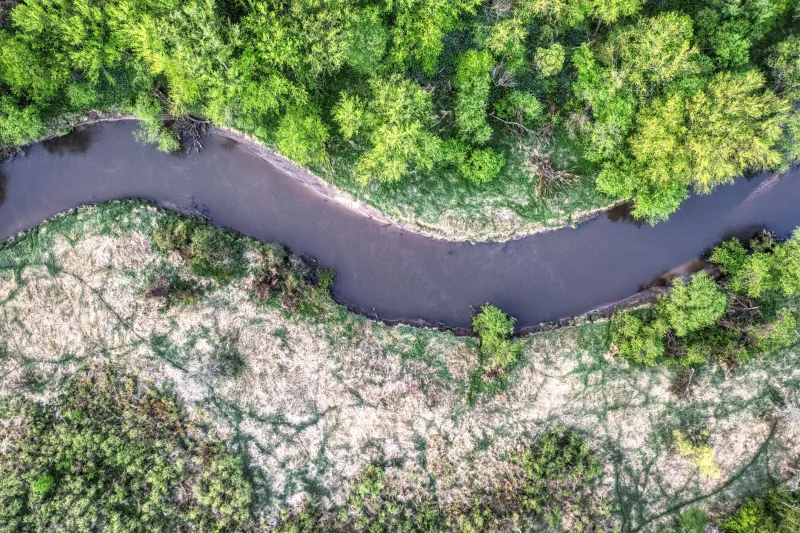
The ecological richness of a natural river is inseparable from its physical complexity. Meanders create an extraordinary range of microhabitats within a relatively short stretch of waterway. The outside of a bend, where current velocity is highest, scours deep pools that provide cool, oxygenated refuge for fish during summer heat. The inside of the same bend accumulates sediment into point bars—shallow, warm, productive zones where invertebrates thrive and juvenile fish find shelter from predators. Oxbow lakes, cut off from the main channel when a meander eventually migrates and closes, become productive wetland habitats supporting amphibians, waterfowl, and specialized aquatic plants.
When a river is straightened, all of that structural diversity collapses into a single habitat type: a uniform channel of consistent depth and velocity. Research published over the past three decades has consistently demonstrated that channelized reaches support dramatically fewer fish species, lower invertebrate diversity, and reduced populations of riparian-dependent birds than comparable natural reaches. A landmark study of channelized streams in the Midwest found that straightened sections supported fewer than half the fish species present in unmodified reference reaches just miles away.
The damage extends beyond the channel itself. Natural river meanders maintain a dynamic relationship with the surrounding floodplain, periodically inundating adjacent land and exchanging nutrients, organic matter, and organisms with terrestrial ecosystems. Channelization severs that connection. The floodplain dries, its wetland vegetation gives way to upland species or row crops, and the nutrient cycling that once linked river and land is broken.
Sediment Transport and the Cascading Consequences
Perhaps the least visible but most consequential effect of channelization involves sediment. Natural rivers exist in a state of dynamic equilibrium with their sediment loads, depositing material in some locations and eroding it in others according to the geometry of their channels. Meanders are central to this process. The alternating pattern of erosion on outer bends and deposition on inner ones creates a continuous redistribution of sediment that maintains channel depth, builds floodplain soils, and supplies downstream reaches with the gravel and sand that aquatic organisms depend upon.
A straightened channel disrupts this equilibrium in ways that are both immediate and self-perpetuating. With the sinuosity removed, water velocity increases—sometimes dramatically—because the channel now covers less distance over the same gradient. That increased velocity translates directly into greater erosive power. Channelized rivers frequently exhibit severe bank erosion and channel incision, cutting downward into their beds as they attempt to dissipate the excess energy their new geometry has imposed upon them. As the channel incises, the water table around it drops, drying out adjacent wetlands and severing the hydrological connection between river and floodplain even further.
Downstream, the consequences of altered sediment dynamics extend to coastal systems. Rivers that once delivered consistent loads of sediment to deltas and estuaries now carry erratic pulses of material, or deliver sediment that has been so thoroughly reworked by channel incision that its grain size and composition no longer support the filter-feeding invertebrates and spawning habitats that coastal ecosystems require.
Re-Meandering: Restoring the Curves That Ecology Requires
The science of river restoration has matured considerably over the past two decades, and one of its most promising—and logistically demanding—tools is re-meandering: the deliberate reintroduction of curves, pools, and floodplain connectivity to channelized reaches. The concept is not new, but the sophistication with which it is now applied has improved substantially.
The Kissimmee River restoration, one of the largest river restoration projects in United States history, offers perhaps the most compelling evidence of what re-meandering can accomplish. Beginning in the 1990s and continuing through the 2010s, restoration crews backfilled portions of the drainage canal and allowed the river to reoccupy segments of its historic channel. The results have been striking. Wetland vegetation has recolonized thousands of acres of former floodplain. Wading bird populations have increased substantially. Fish species that had largely disappeared from the channelized reach have returned.
Smaller-scale re-meandering projects on agricultural streams in the Midwest and Mid-Atlantic have demonstrated similar patterns of recovery, often at costs that compare favorably with the ongoing expense of maintaining channelized systems that require continuous dredging and bank stabilization. Researchers at several land-grant universities have developed predictive models that allow restoration practitioners to design re-meandered reaches that will remain stable under projected flow regimes—addressing one of the primary concerns that historically made landowners and agencies reluctant to abandon straightened channels.
The Political Geography of Recovery
Restoring channelized rivers is not merely a scientific challenge. The land surrounding straightened rivers has, in most cases, been in agricultural or commercial use for generations. Farmers who depend on artificially lowered water tables, municipalities whose stormwater infrastructure was designed around channelized streams, and navigation interests that rely on maintained waterways all have legitimate stakes in any restoration conversation.
Progressive river policy must acknowledge those stakes while making the case—grounded in both ecological science and long-term economic analysis—that the costs of maintaining ecologically degraded rivers are not zero. Channelized rivers require perpetual maintenance. They deliver degraded water quality to downstream communities. They fail to provide the flood attenuation, groundwater recharge, and fisheries productivity that intact river systems generate as a matter of course.
The ghost of those erased meanders haunts American waterways in the form of impaired water quality, collapsed fish populations, and landscapes stripped of their ecological resilience. Restoring those curves is among the most consequential investments this country can make in the long-term health of its rivers—and the communities, both human and wild, that depend on them.