Headwaters First: How America's Smallest Streams Hold the Key to Watershed-Wide Recovery
On any map of America's rivers, it is the great waterways that command attention—the Mississippi, the Colorado, the Columbia. These iconic corridors attract the bulk of conservation funding, scientific scrutiny, and public imagination. Yet for every mile of major river charted in bold blue ink, dozens of smaller tributaries branch outward like capillaries, quietly performing the biological and hydrological work that sustains the entire system. These are the forgotten headwaters, and their neglect may be one of the costliest oversights in American environmental policy.
Small streams—defined broadly as first- and second-order waterways that feed into progressively larger channels—collectively account for more than half of the total stream length in the continental United States. Some estimates place the figure closer to 70 percent when seasonal and intermittent flows are included. Despite their numerical dominance, these waterways receive a fraction of the restoration investment directed toward mainstem rivers. The consequences of that imbalance are becoming increasingly difficult to ignore.
The Science of Tributary Leverage
Hydrologists have long understood that watershed health is cumulative. Whatever enters a small stream—sediment, nutrients, temperature, biological material—does not simply disappear. It travels downstream, compounding with inputs from neighboring tributaries before arriving, transformed, at larger channels. This principle, sometimes described as tributary leverage, means that degradation in a headwater stream can manifest as measurable impairment many miles away in a river that appears, on the surface, to be entirely separate from the problem.
Dr. Margaret Shriver, a fluvial geomorphologist who has studied tributary dynamics in the Appalachian region for more than two decades, describes the relationship in straightforward terms. "People think of stream restoration as fixing a specific reach," she explains. "But the river doesn't understand property lines or project boundaries. What happens at elevation two thousand feet shows up at elevation two hundred feet. The headwaters are writing the story before anyone downstream has a chance to read it."
The inverse of this principle is equally compelling. Restore a degraded tributary—stabilize its banks, reestablish riparian vegetation, reduce fine sediment loads—and the benefits propagate downstream with remarkable efficiency. Studies conducted in the Chesapeake Bay watershed have demonstrated that targeted restoration of small agricultural streams can reduce nitrogen and phosphorus loading to mainstem rivers by measurable percentages, contributing to improvements in estuary water quality that would have required far larger and more expensive interventions had they been attempted at the receiving end of the system.
Cheaper, Faster, and Often More Effective
Beyond the ecological logic, there is a compelling economic argument for prioritizing tributary restoration. Small-stream projects typically require less permitting, involve fewer competing stakeholder interests, and can be completed with smaller crews using lighter equipment. A restoration effort that would cost tens of millions of dollars on a major river—rerouting channels, constructing engineered grade controls, negotiating with municipal water authorities—may be achievable on a tributary for a fraction of that figure.
The Henry's Fork Watershed Council in Idaho has demonstrated this principle repeatedly over the past decade. Working with ranching families and federal land managers, the organization has restored dozens of small tributary reaches feeding into the Henry's Fork of the Snake River. Interventions have included fencing livestock away from stream corridors, reintroducing native willows and sedges, and installing low-cost woody debris structures to slow water velocity and rebuild channel complexity. The cumulative effect on mainstem water temperature and sediment clarity has been significant, contributing to improved habitat conditions for native trout populations that depend on cold, clear water during critical spawning periods.
Similar outcomes have been documented in the Driftless Area of Wisconsin and Minnesota, where a network of small spring-fed streams feeds the upper Mississippi watershed. Local conservation districts, working alongside the Natural Resources Conservation Service, have channeled USDA funding into tributary buffer restoration programs that have measurably reduced turbidity in receiving waters while simultaneously improving farm field drainage—a combination that has made the approach politically viable in an agricultural landscape where conservation and production are often framed as opposing values.
The Regulatory Gap That Leaves Small Streams Vulnerable
Despite the scientific consensus around their importance, small streams remain poorly protected under existing federal law. The legal status of many headwater and intermittent streams under the Clean Water Act has been contested for decades, with a succession of Supreme Court decisions and agency rule changes creating persistent uncertainty about which waterways qualify for federal jurisdiction. The practical result is that developers, agricultural operators, and municipalities can alter or eliminate small streams with far less regulatory scrutiny than would apply to navigable waters.
Environmental law scholars and watershed advocates have repeatedly called for clarification and expansion of protections for these systems. Until such protections are established on firm legal footing, the burden falls disproportionately on state agencies, local conservation districts, and nongovernmental organizations to fill the gap—a task they are often underfunded to accomplish at the scale the problem demands.
Building a Tributary-First Framework
Advocates within the restoration community are increasingly calling for a fundamental reorientation of how watershed planning is conducted. Rather than treating small streams as secondary features that can be addressed after larger problems are resolved, a tributary-first framework would begin restoration planning at the headwaters and work systematically downstream. This approach aligns with the natural direction of ecological influence and allows practitioners to address root causes of degradation rather than managing symptoms at the receiving end.
Several state programs have begun moving in this direction. Oregon's Watershed Restoration Initiative has incorporated tributary assessment into its basin planning process, requiring that headwater conditions be evaluated before restoration priorities are established for larger channels. In North Carolina, the Clean Water Management Trust Fund has directed increasing proportions of its grant dollars toward small-stream buffer acquisition and restoration, citing the cost-effectiveness data as a primary justification.
Federal programs, including the Environmental Quality Incentives Program and the Regional Conservation Partnership Program, offer existing mechanisms through which tributary restoration can be funded on private agricultural lands. Expanding awareness of these tools among landowners—and simplifying the application processes that currently deter participation—represents a near-term opportunity that does not require new legislation.
What Scaling Up Requires
The case for tributary restoration is scientifically robust, economically sound, and ecologically urgent. What it lacks is scale. Thousands of degraded headwater streams exist across every region of the country, and the pace of restoration work, while meaningful, has not kept up with ongoing losses. Closing that gap will require sustained investment, expanded federal and state protections, and a cultural shift in how the conservation community—and the public—perceives the significance of small waterways.
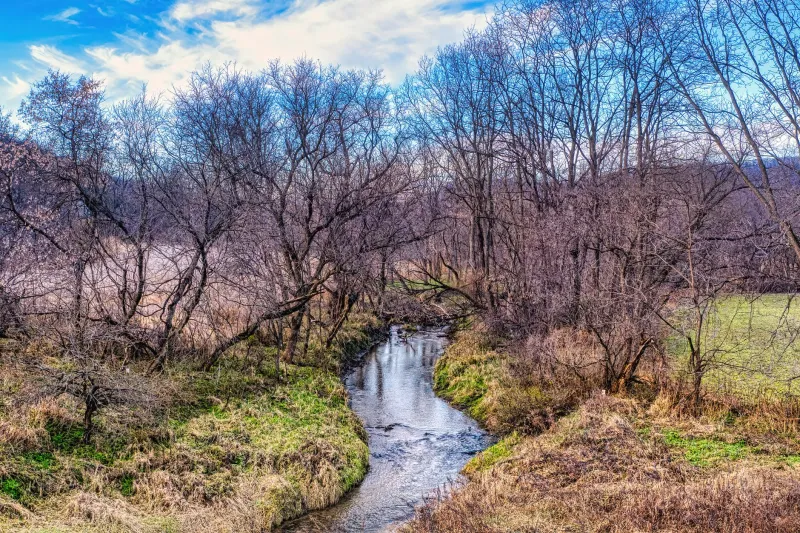
A stream that can be stepped across in a single stride may not inspire the same reverence as a river that commands a bridge. But that modest thread of water, threading through a meadow or a woodlot or a farm field, is where the watershed begins. It is where temperature, chemistry, sediment, and biology are first established. It is, in the most literal sense, the origin of everything downstream.
Restoring America's rivers at the scale the ecological crisis demands will require working from that origin outward—starting small, thinking systemically, and recognizing that the tributaries most easily overlooked may be the ones most worth protecting.